


Most on-prem AI security conversations stop at the network boundary. Air gap the cluster, put SSO in front of the chat UI, log the prompts, done. The research CNN published on October 29, 2026 is a reminder that the boundary is a lot lower than that. Researchers at Eclypsium showed that an attacker on the right network can reach a baseboard management controller or data processing unit, read and modify what sits in GPU memory, and change what the model says, in under a minute, without the user noticing.
If you are buying hardware to run large models inside your own walls, the attack surface you need to think about now includes BMC firmware, GPU VBIOS, the DPU, the supply chain that got the box to your dock, and the weights sitting in HBM at inference time. This piece walks through that surface and gives you a buyer-facing checklist you can hand to a vendor.
So what does a hardware-level threat model for an on-prem LLM actually look like?
Why the Hardware Layer Is Suddenly the Story
For a decade, server security meant patching the OS and keeping iDRAC or iLO off the public internet. AI changed the stakes. An AI server concentrates model weights worth millions of dollars in training cost, high-value business data flowing through retrieval pipelines, and output that users treat as authoritative. Eclypsium's report describes a model-tampering technique that altered runtime state after traditional security checks ran, so integrity verification reported a clean system. The same report notes that systems from Nvidia, AMD, Intel and Arm are affected.
The CNN scenarios are concrete. In one demonstration, the researchers raised the probability the model assigned to a Chinese invasion of Taiwan by remotely tampering with the weights; in another, a tampered model told a user with chest pain to stay home instead of going to the hospital. You cannot patch that behavior out of a model that has been quietly reshaped underneath it.
Independent reviewers agreed the technique is sound rather than exotic. Hardware security researcher Joe FitzPatrick told CNN the attacks are fundamentally the same as other direct memory access attacks and said he saw no reason to doubt the findings. The vectors are old. The target is new.
The Hardware Attack Surface, Component by Component
Think of an AI server as a stack of small computers that happen to share a chassis. Each one is reachable, each one runs code, and most of them boot before the hypervisor you trust does.
- BMC. The baseboard management controller is a separate CPU with its own network interface, its own OS, and full control over the host. CNN reported that researcher HD Moore disclosed multiple BMC vulnerabilities this summer, and the Eclypsium work uses those same classes of flaws as a way in.
- DPU. A data processing unit is a system on a chip that helps run data centers; with access to it, an attacker can read and modify code and data in the machine's memory. It sits on the PCIe fabric, which means it can touch GPU memory directly.
- UEFI and GPU VBIOS. Firmware that runs before the kernel. Compromise here persists through reinstalls and is invisible to endpoint tooling that only watches user space.
- Management plane. Eclypsium's report describes compromise of the management plane as a path to firmware modification, changes to isolation controls, and direct control of attached devices.
- Weights at rest and in HBM. On-disk weights can be encrypted. Weights loaded into GPU memory for inference generally cannot be, and that is where the research reaches them.
If this list looks familiar, it should. Binarly researcher Alex Matrosov noted that the supply chain, UEFI and BMC attack vectors discussed in NIST SP 800-239 are decades old, and that what has changed is the complexity of modern servers. AI just raised the payout.
Supply Chain Is Part of the Threat Model
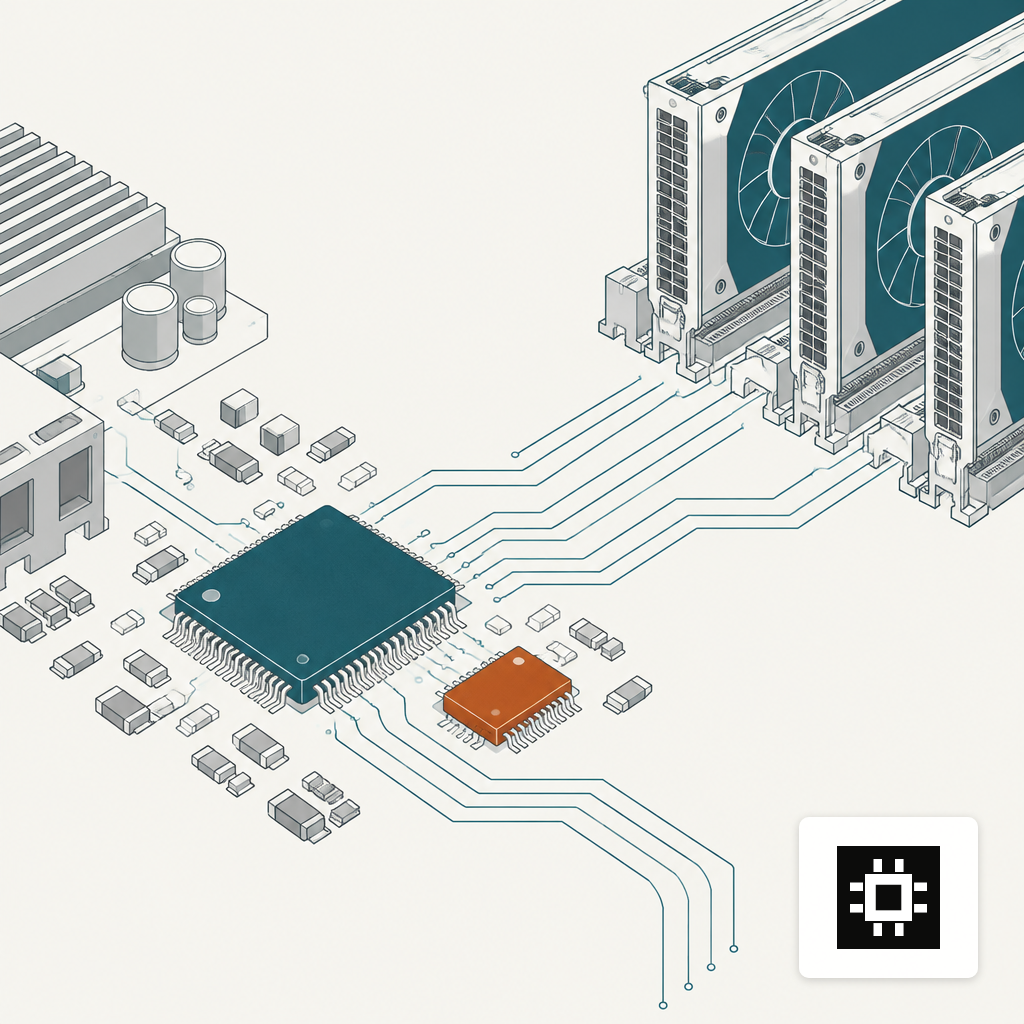
A GPU server is assembled from parts made by dozens of suppliers, flashed with firmware signed by different vendors, and shipped through a logistics chain you did not design. Each step is a chance for something to be swapped, modified or pre-infected before the box ever reaches your loading dock.
The federal response is catching up. NIST released the initial public draft of SP 800-239, AI Data Center Security Analysis: A High-Performance Computing (HPC) Driven Approach, which implements the AI Action Plan's call for technical standards for high-security AI data centers. The draft discusses hardware root of trust and confidential computing as advancements that can enhance security while allowing high performance, and calls for a security-by-design and verification-by-design approach across the data center lifecycle.
Translated into procurement terms, that means asking vendors specific questions about parts provenance, firmware signing, and what happens to a failed accelerator when it leaves your site. A reading of the NIST draft points out that a failed accelerator returned to a vendor may still contain local data or configuration, and that procurement requirements should include security-update commitments and disclosure processes, not only performance targets. The questions to ask a vendor before signing an on-prem AI contract start here.
A Buyer-Facing Hardening Checklist
None of the following is exotic. All of it is the kind of thing a serious vendor will have an answer for before you ask, and the kind of thing you want written into the contract rather than discovered during a penetration test.
Isolate the Management Plane
Put BMC and IPMI interfaces on a dedicated, physically separate network. No shared VLAN with production, no route to the internet, access only from a jump host that requires MFA. If the vendor's reference architecture puts the BMC on the same switch as the inference traffic, push back.
Enforce Signed Firmware End to End
Secure boot on the host, signed BMC firmware, signed GPU VBIOS, signed DPU firmware. Verify signatures at boot and periodically at runtime. Keep a known-good hash manifest for every component so drift is visible. This is the hardware root of trust NIST describes, applied to the whole machine rather than just the CPU.
Lock Down Direct Memory Access
Enable IOMMU and ensure PCIe devices only see memory they are meant to see. Disable unused PCIe slots in UEFI. If your workload does not need a DPU, do not accept one in the build; every powered-on component is attack surface.
Treat the Supply Chain as In-Scope
Require a software bill of materials for firmware as well as software. Ask who flashes the components, where, and under what controls. Record component serial numbers at receipt and verify them against the vendor's shipping manifest. For high-sensitivity sites, specify tamper-evident packaging and inspect it.
Protect Weights Through Their Full Lifecycle
Encrypt weights at rest with keys held in a hardware security module, not on the same disk. Restrict who can write to the weight store, log every read, and alert on any process that is not your inference server pulling from it. For sensitive deployments, confidential computing modes that keep weights encrypted in GPU memory are maturing and worth asking about by name.
Monitor Firmware and Memory, Not Just Logs
Deploy agents or out-of-band tooling that watches for firmware changes, unexpected PCIe devices, and anomalous DMA activity. Pure syslog monitoring will miss the attacks described in the CNN research by design.
Plan for Decommissioning
Define, in writing, what happens to a failed GPU. Return-to-vendor with weights still resident is a leak. Options include on-site destruction, cryptographic erasure with vendor attestation, or buyback terms that keep the part under your control.
Where This Fits in a Buying Decision
Hardware-level security is one of the stronger arguments for keeping LLM workloads on your own iron. You cannot inspect a cloud provider's BMC firmware or audit who last flashed the GPU VBIOS in a shared tenancy. On vendor-neutral AI systems you own, you can. The trade-off is that you also own the responsibility.
Match the hardening work to the sensitivity of the workload. A cstmAI Desk workstation running a coding assistant for a small team needs signed firmware, a locked BMC and sensible network segmentation. A GPU cluster hosting a fine-tuned clinical model, or one supporting financial services data residency and access, needs the full checklist above, plus the kind of ongoing firmware monitoring most IT teams do not currently run.
Sizing and segmentation choices interact. If you are still mapping GPU count and VRAM to your workload, start with the AI hardware estimator, then come back to this checklist before you sign.
What to Do This Week
Three concrete steps you can take before the next CNN story on this topic lands.
- Audit your current AI server management network. Confirm BMC interfaces are not reachable from user networks and that firmware is current. The HD Moore disclosures referenced in the CNN piece are a reasonable place to start a CVE sweep.
- Add firmware and supply chain questions to your next hardware RFP. Signed boot, SBOM for firmware, decommissioning terms, vendor response SLA for new BMC CVEs.
- Decide which workloads need weight-at-rest encryption with external key management, and which can tolerate the simpler setup. Not every model needs the same treatment, and over-hardening a pilot wastes budget you will want for the production system.
The Eclypsium research is not a reason to delay on-prem AI. It is a reason to buy it from a builder who treats firmware, the BMC, the DPU and the supply chain as part of the product rather than someone else's problem. If you want to talk through what that looks like for a specific workload, request a quote and we will walk the stack with you.