
For a 4-8 GPU rack, air cooling is the right choice up to around 20 kW per rack, rear door heat exchangers stretch that envelope into the 40-120 kW band, and direct-to-chip liquid is where you move when the silicon itself asks for it. That sentence is the whole decision. What changes between the three paths is what your building has to supply, what your installer has to connect, and what your facilities team is signing up to run on day 180. The rest of this piece walks each option from receiving dock to steady state so a buyer can price the choice honestly, not just the server.
Where Air Cooling Actually Runs Out
A standard enterprise computer room is built for rack loads of 5-10 kW. It will host an AI server or two without complaint. A 4-GPU system on H100s or RTX PRO 6000s draws roughly 4-6 kW under sustained inference and more during training, and the 4-GPU cost drivers are the first place facilities surprises show up on a budget sheet. Stack two of those servers in a rack and containment stops being optional. An 8-GPU configuration lands at or past 20 kW on its own.
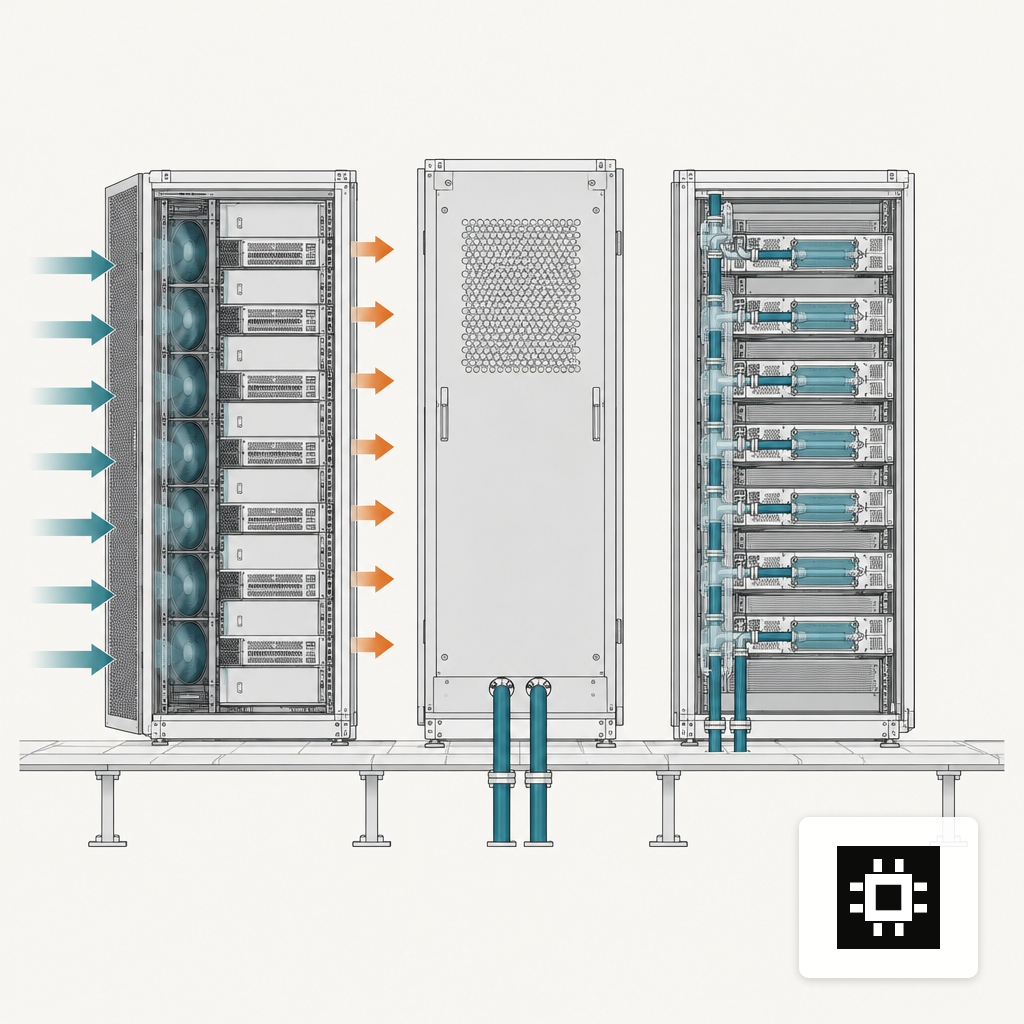
Air can still handle the job above that line, but the room has to work for it. Hot-aisle or cold-aisle containment becomes mandatory. Supply air volumes rise. Fans at the server front spin harder, and the acoustic floor of the room climbs with them. By about 25 kW per rack most operators have added a dedicated in-row cooler or crossed over to a liquid-assisted path. A longer primer on that transition sits in power, cooling and noise.
Rear Door Heat Exchangers as the Middle Path
A rear door heat exchanger (RDHx) replaces the rack's rear panel with a water or refrigerant coil. The servers still breathe in air at the front and exhaust hot air at the back; the coil absorbs that heat before it enters the room. Passive doors handle 15-30 kW with no fans. Active doors with assist fans push into the 40-80 kW range. At the top end, OptiCool's 120 kW two-phase door targets rack densities that air alone cannot reach.
The advantage is pragmatic. The servers themselves are unchanged. You can retrofit a few racks without touching the rest of the room, and if the coolant distribution unit (CDU) ever trips, the servers keep running on air long enough to react. The cost is piping: every RDHx-cooled rack needs supply and return lines from a CDU, and the CDU itself needs a path to a dry cooler, cooling tower or chilled water plant.
Direct-to-Chip Liquid at the Rack
Direct-to-chip (DTC) cooling clamps cold plates to the GPU and CPU dies and runs a sealed coolant loop through them. The silicon hands its heat straight to the liquid instead of to the fan curtain in front of it. Residual components (memory, NICs, drives, PSUs) still shed heat to air, so a DTC rack is never truly air-free, but the heavy load leaves through the pipes.
DTC is what you install when the GPU vendor has already decided the question for you. The newest accelerator classes ship in liquid-cooled sleds because their thermal design points no longer fit in an air-cooled chassis envelope. On older generations it remains a choice, and the trade is clear: much higher density per rack, lower acoustic load, better electrical efficiency at the wall, in exchange for a plumbed facility and a maintenance regime your team has not run before.
What Each Option Asks of the Building
Before committing, three facility checks decide more than the server choice does.
- Power. An 8-GPU server routinely draws 6-10 kW. Two of them exceed most 30 A, 208 V PDU budgets, and a four-server row needs 400 V three-phase or a redesigned power layout upstream.
- Floor loading. A fully populated rack with liquid manifolds and a CDU can exceed 1,500 kg. Legacy raised floors were often rated for far less.
- Water or refrigerant delivery. RDHx and DTC both require a secondary loop. ASHRAE's W-class scale describes the supply water temperature your facility can deliver, and W32 and above lets you skip a mechanical chiller entirely in most temperate climates.
None of this is unusual for a colocation cage. It is often new for a corporate server room, and that is where the discovery sprint earns its keep. The four cstmAI sizes are each matched to a realistic facility profile, so the Rack and Cluster conversations always open with these three questions before silicon.
The Install Sequence From Dock to Commissioning
Air-cooled installs are the shortest. Receive, rack, cable, energize, burn in, hand over. On an existing properly conditioned row, a single server can be in production inside a week. A new row with containment work added runs three to six weeks depending on electrical trades.
RDHx adds a secondary loop. The CDU is placed, hard-plumbed to the facility heat rejection, filled, pressure-tested and flushed before any door is hung. Doors are swapped in rack by rack, and each one is leak-tested on commissioning. Add two to six weeks to the air baseline, more if the building had no process water at all.
DTC is the longest first install. Cold plates arrive bonded to the servers from the factory, but manifolds, quick disconnects and the CDU-to-rack piping are site work. Leak testing is done empty, then with deionized coolant, then under flow. Every quick disconnect is a maintenance point for the life of the rack. Budget eight to fourteen weeks beyond air for a first DTC row and shorter for each subsequent one.
The Operating Load After Day One
Day one is not where cooling choice ends. Each path imposes a different ongoing operating cost.
Air rooms run at high fan power at high density, and PUE climbs as the IT load grows. Vertiv's PUE modeling shows that moving even part of the load to liquid can shave tenths off a facility PUE at the same workload.
Water-cooled paths bring water usage into the conversation. Industry-average water usage effectiveness sits at 1.8-1.9 L/kWh of IT energy, best-in-class facilities reach around 0.7 L/kWh, and closed-loop systems with dry coolers approach zero. US data centers consumed about 17 billion gallons of water directly for cooling in 2023, and that number is the reason site selection committees now ask about closed loops.
The maintenance load also diverges. Air racks need filter changes and fan replacements. RDHx racks add coolant chemistry, pressure checks and door seal inspection. DTC racks add all of the above plus manifold and quick-disconnect servicing. The engineering is not exotic, but it is a different weekly checklist, and any RFP for custom AI hardware should name who performs it.
Sorting the Choice
Three situations cover most buyers walking into this decision.
If you are putting one or two 4-GPU servers into an existing enterprise room and the rack load stays under 20 kW, buy air. Add containment, confirm the breaker budget, and route the install like any other rack deployment. Nothing about the facility needs to change.
If you are planning a 4-8 GPU rack, or a row of them, in a room that already has chilled water or can accept a dry cooler on the roof, price a rear door heat exchanger. It handles the density you are heading toward, keeps the servers vendor-neutral, and does not force a liquid-ready chassis today.
If the GPU generation you have specified only ships in a liquid-cooled form, or you are standing up multi-node training on tens of accelerators, move straight to direct-to-chip and include the loop, the CDU and the facility interface in the same quote as the hardware.