


Picking a QPU for VQE Chemistry at 20 to 50 Qubits
Compare IonQ Forte, Quantinuum H2, and IBM Heron for 20 to 50 qubit VQE chemistry runs by fidelity, connectivity, circuit depth, and per-shot cost.
Ask a computational chemist which processor to book for a 30-qubit VQE run and you will get three different answers depending on who they talked to last. The vendor decks all show green checkmarks. The benchmark blogs measure different things. And the price sheets are written in three incompatible currencies.
This guide narrows the field to the three processors most teams actually short-list for near-term variational quantum eigensolver chemistry in the 20 to 50 qubit range: IonQ Forte, Quantinuum H2, and IBM Heron. The comparison is deliberately workload-specific. VQE circuits are shallow but shot-hungry, dominated by two-qubit gates in a UCCSD or hardware-efficient ansatz, and iterated thousands of times inside a classical optimizer loop. That workload rewards fidelity and connectivity, punishes long queues, and makes per-shot pricing a first-order concern rather than a footnote.
So which processor should you run on?
What VQE Actually Demands From a QPU
VQE prepares a parameterized ansatz, measures the energy expectation of a molecular Hamiltonian, and hands the result to a classical optimizer that updates the parameters. The loop repeats until the energy stops falling. The target is chemical accuracy, defined as roughly 1 kcal/mol or about 1.6 millihartree from the exact ground-state energy. Missing that by an order of magnitude means the run has produced a number, not a chemistry result.
Three hardware properties dominate whether a VQE circuit reaches that target at 20 to 50 qubits:
- Two-qubit gate fidelity. Ansatz depth grows with the number of excitations, and every entangling gate multiplies error. A percent of infidelity per gate compounds fast across the hundreds of two-qubit gates in a UCCSD circuit for a mid-sized molecule.
- Connectivity. All-to-all coupling lets the compiler place any fermionic excitation without inserting SWAP chains. On a heavy-hex lattice, non-local excitations cost extra CNOTs, which cost extra fidelity.
- Shot economics. A single VQE iteration on a 30-qubit Hamiltonian can require tens of thousands of shots across grouped Pauli terms. Hundreds of iterations turn per-shot pricing into the dominant line item.
The ansatz choice interacts with all three. A benchmarking study across more than ten VQE ansatzes on systems up to 30 qubits found ADAPT produces more accurate energies for small systems below 14 qubits but costs much more computational resources, while UCCSD0 performs better for larger molecules. Whichever ansatz you pick, the two-qubit gate count is what the hardware has to survive.
IonQ Forte Delivers All-to-All Coupling at 36 Qubits
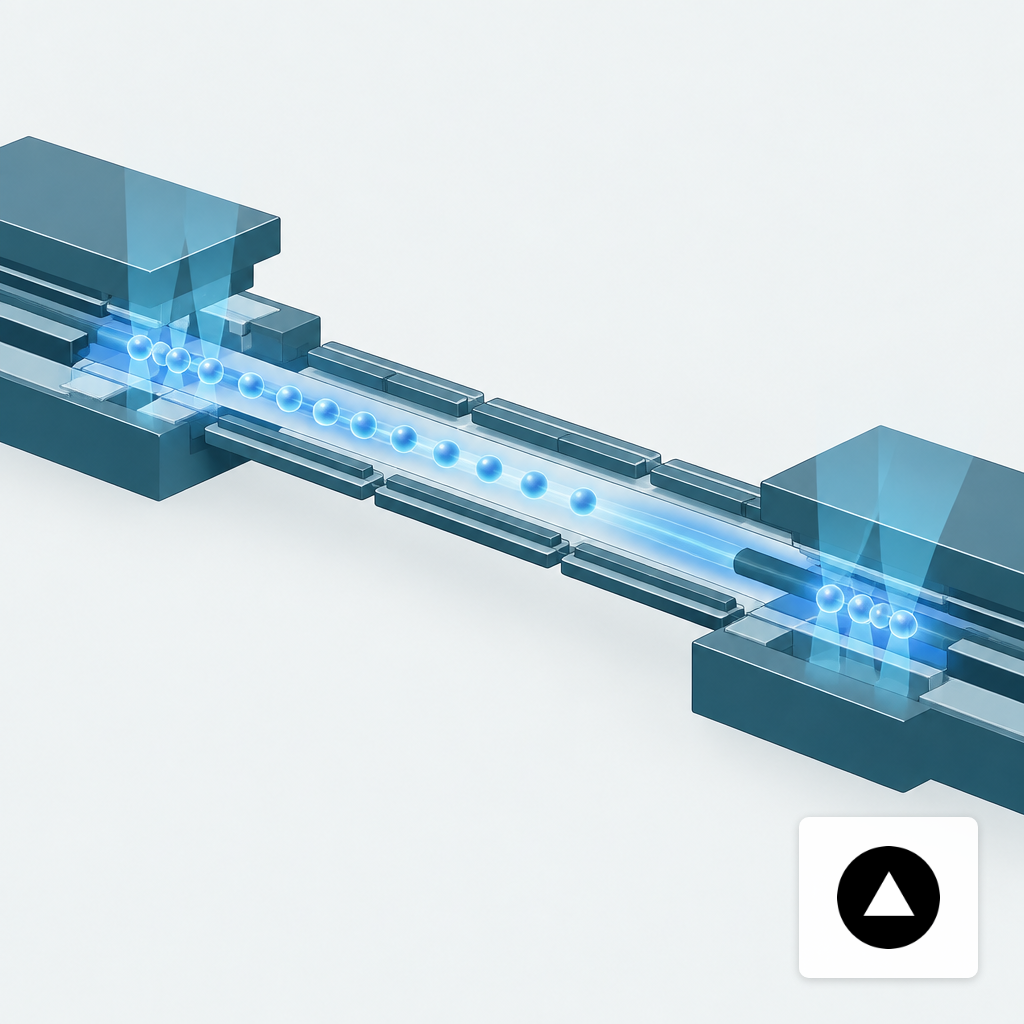
Forte and Forte Enterprise each house 36 qubits realized with trapped Ytterbium-171 ions, with median direct randomized benchmarking two-qubit gate fidelities of 99.3% on Forte and 99.5% on Forte Enterprise, and around 99.98% single-qubit fidelity. Connectivity is all-to-all by construction: any ion can be paired with any other through the shared motional modes of the chain.
For a UCCSD run on a molecule like BeH₂ or a small transition metal complex, all-to-all coupling removes the SWAP overhead entirely. A double excitation between distant orbitals compiles to the same gate count as a nearest-neighbor one. That matters because the SWAP tax on a fixed lattice is not a constant factor. It scales with the diameter of the excitation network.
The trade-off is throughput and cost. Trapped-ion two-qubit gates are slower than superconducting equivalents, and on AWS Braket a 10,000-shot Forte task runs about $800 compared with roughly $4.55 on a Rigetti superconducting device. For a VQE loop that needs 200 iterations at 20,000 shots each, that is a real number.
Quantinuum H2 Trades Qubit Count for Gate Quality
Quantinuum upgraded H2-1 from 32 to 56 trapped-ion qubits, maintaining all-to-all qubit connectivity, mid-circuit measurement, qubit reuse, and feed forward capabilities. The QCCD architecture physically shuttles ions between gate zones, which is what makes the all-to-all pairing real rather than logical.
Gate quality is the headline argument for H2. The joint Microsoft-Quantinuum logical qubit demonstration reported 99.8% two-qubit gate fidelity on H2, using 30 of 32 physical qubits to create four logical qubits. For a chemistry workload, that fidelity translates directly into deeper survivable ansatzes at the same qubit count.
The catch is billing and access. Quantinuum meters usage in Hardware Quantum Credits, and the H2 HQC formula scales with N₁q + 10·N₂q + 5·Nₘ, weighting two-qubit gates ten times single-qubit ones. That is honest pricing: it makes deep circuits expensive because deep circuits are expensive to execute. It also makes cost modeling non-trivial for a VQE run where the exact gate count depends on the ansatz and the fermion-to-qubit mapping.
IBM Heron Wins on Depth Budget and Availability
IBM Quantum Heron features 133 fixed-frequency qubits with tunable couplers, yielding a 3-5x improvement in device performance over the previous 127-qubit Eagle processor and virtually eliminating cross-talk. The Heron R2 revision pushed further: the 156-qubit R2 combined with Qiskit can perform up to 5,000 two-qubit gate operations, roughly doubling the previous 2,880 two-qubit gate depth benchmark.
Heron uses a heavy-hex lattice. Every qubit connects to two or three neighbors, not all others. For a hardware-efficient ansatz that respects the lattice, this is fine. For UCCSD on a Jordan-Wigner mapping, non-local fermionic terms compile into SWAP networks that inflate the two-qubit gate count. The compiler is good, and Qiskit's transpiler will exploit the tunable couplers, but the topology tax is real at 40 to 50 logical qubits.
Where Heron pulls ahead is throughput per dollar. Superconducting gates are microseconds fast versus tens of microseconds for trapped-ion, and IBM's per-minute Qiskit Runtime pricing rewards short circuits. For a hardware-efficient ansatz with shallow entangling layers on 40 qubits, Heron will complete a VQE loop in a fraction of the wall-clock time either trapped-ion system needs, at a materially lower total cost. The full processor landscape and current calibration data across vendors is tracked on the compare quantum processors tool.
Matching the Molecule to the Machine
The right choice depends on molecular structure and ansatz strategy more than on any single fidelity number. A workable decision rule:
- Small molecule, UCCSD, publication-grade accuracy (20 to 30 qubits): Quantinuum H2 is the defensible pick. The fidelity headroom absorbs the deeper ansatz, and all-to-all connectivity keeps the two-qubit count honest. Budget accordingly.
- Mid-size molecule, UCCSD or ADAPT, active-space chemistry (30 to 40 qubits): IonQ Forte Enterprise sits in the middle. Connectivity matches H2, cost per shot is high but predictable on Braket, and the 36-qubit ceiling fits the workload.
- Hardware-efficient ansatz, large basis, method development (40 to 50 qubits): IBM Heron R2. The depth budget and lattice-native ansatz choice make superconducting the pragmatic answer, provided you accept that the numerics will be error-mitigated rather than error-corrected.
None of these are permanent verdicts. Fidelity numbers move quarter to quarter, and calibration data drifts inside a single week. Reproducibility for a VQE result depends on citing the calibration snapshot the run used, which is why current specifications tracked on QPU benchmarks matter more than a headline number from a press release.
- 1Fix the Hamiltonian and fermion-to-qubit mapping
- 2Estimate two-qubit gate depth of the chosen ansatz
- 3Apply an error budget against current 2Q fidelities
- 4Model per-shot cost across candidate providers
- 5Reserve time on the processor that fits all three
The Selection Workflow Worth Following
A defensible hardware pick for VQE chemistry looks less like a shopping decision and more like a sizing exercise. Start with the Hamiltonian, not the vendor. Count the qubits your fermion-to-qubit mapping actually requires, estimate the two-qubit gate depth of the ansatz you plan to use, and multiply by an honest error budget to see whether the target molecule is reachable at all on current fidelity. Then, and only then, compare providers against that specific number.
The three systems here are not interchangeable. Trapped-ion architectures buy accuracy at the cost of throughput. Superconducting buys throughput at the cost of connectivity. Neither buys chemical accuracy by itself on a 50-qubit active space today. That is the honest state of the field, and it is why hardware selection for VQE remains a live engineering decision rather than a solved problem. Details on each architecture and its native gate set are catalogued in the quantum computing architectures reference, and the vendor cloud endpoints and queue depths are tracked on QPU availability.