The headline specs on these systems, eight SXM5 GPUs plus dual Xeons and 32 DDR5 DIMMs, are nearly identical, so lining them up tells you little about which vendor to pick. The real separator is what arrives working and who owns the stack when something breaks.
Three paths show up on most shortlists for an on-prem LLM: a tier-one OEM (Dell PowerEdge XE), a GPU-focused ODM (Supermicro GPU SuperServer), and a custom-built AI server delivered with vLLM, your model and your identity provider already running. The underlying silicon is largely the same across all three. The delivery model is not.
What Each Vendor Delivers
Dell's PowerEdge XE9680 is a 6U rack server with eight NVIDIA HGX H100 or H200 SXM5 GPUs, dual 5th-generation Intel Xeon Scalable CPUs with up to 64 cores each, 32 DDR5 RDIMM slots and six 2,800W Titanium PSUs, as listed in Dell's installation manual. Supermicro's SYS-821GE-TNHR is the same conceptual machine in an 8U chassis, built around the same HGX 8-GPU baseboard with its own PSU and airflow design. Both ship bare metal with BMC firmware and the vendor's enterprise tooling. Neither ships an inference runtime, model weights, authentication, logging or your document pipeline.
A custom integrator sells the same NVIDIA HGX reference platform, usually built from a Supermicro or equivalent chassis, with the software stack installed before the system leaves the factory: a Linux distribution, GPU drivers and fabric manager, an inference runtime, open-weight models, SSO, telemetry and the connector to your documents. Hardware alone is roughly a quarter of the delivered value. The rest is what runs on it on day one.
The Hardware Underneath Is Nearly Identical
Both the Dell and Supermicro 8-GPU systems use NVIDIA's HGX reference baseboard, which fixes the NVLink switch topology, the SXM5 socket geometry and the memory-per-GPU envelope. The chassis differences show up at the edges: U-count, airflow path, drive bay count, PCIe layout for NICs and storage, and serviceability. A team standardized on one vendor across the rest of its fleet will find familiar bezels, BMC conventions and service procedures. The integration savings from that fleet-standardization story are real, if the team has already bought into it.
Where the chassis genuinely diverge is on the Blackwell generation. Dell's XE9680L moves to a 4U liquid-cooled form with direct liquid cooling across CPUs, GPUs and the NVLink switch fabric, enabling 72 Blackwell GPUs per rack. NVIDIA's own GB200 reference design pushes that pattern further, collapsing an entire rack into one NVLink domain. Once Blackwell density arrives, the choice between 8U air-cooled and 4U liquid-cooled matters more than the choice between Dell and Supermicro on the bezel.
Cooling Decides What Fits in Your Room
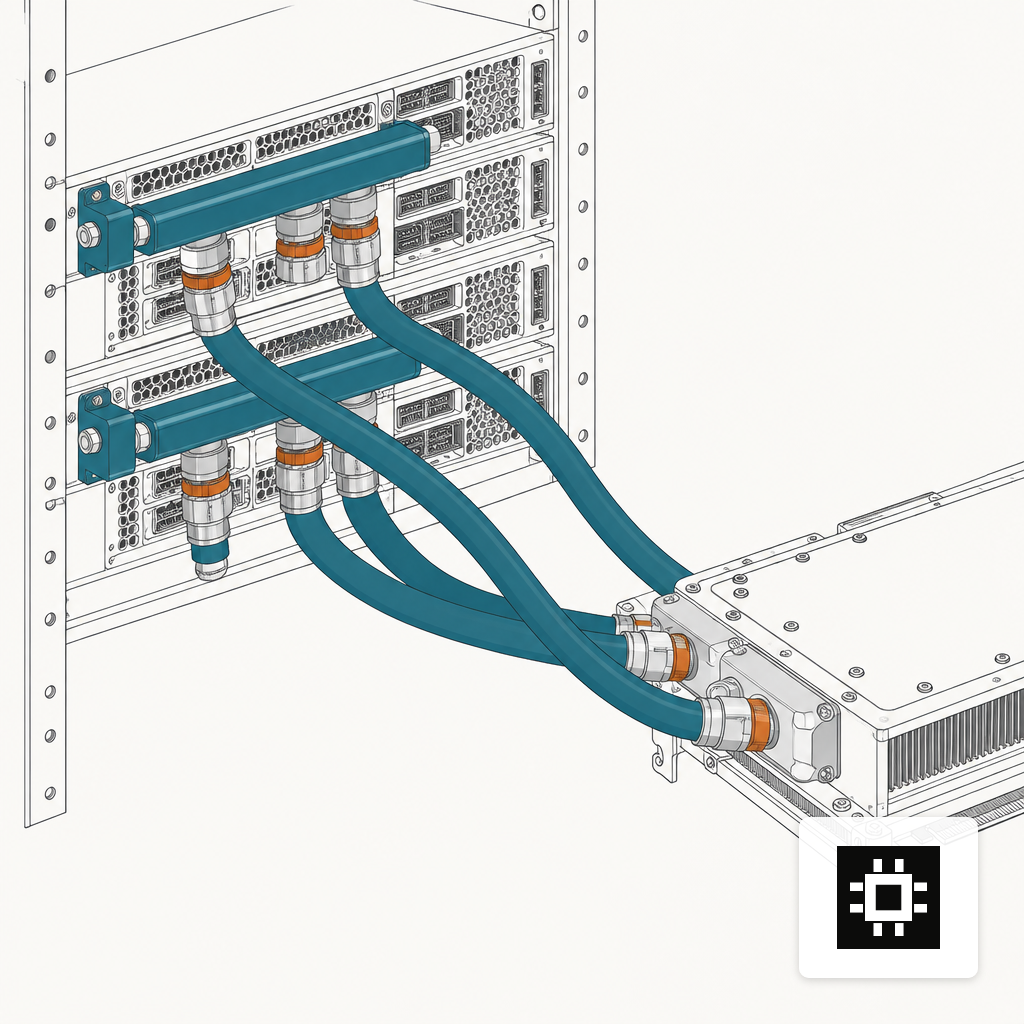
Air-cooled 6U and 8U HGX systems draw well into double-digit kilowatts at full load, demand high airflow, and will heat the back of a traditional aisle to the point where compute is lost to thermal throttling if the room was not designed for it. Dense liquid-cooled racks move to warm-water loops, remove the bulk of system heat into the coolant, and shrink the server footprint significantly. The chart below shows the vendor claim for one well-documented direct-liquid program.
Most on-prem buyers do not have a liquid-ready room on the day the purchase order is signed. That is the single biggest reason a stock Dell or Supermicro purchase can stall for a quarter waiting on facilities work. The liquid vs air cooling piece walks the trade-off in more detail; the summary for this comparison is that a custom integrator can right-size: air-cooled 4U for a pilot, liquid-ready 42U cabinet for scale, and a migration plan between them.
The Software Stack Is Where the Difference Opens
An OEM ships firmware, iDRAC or SSM, and signed OS installers. Standing up an inference server on top of a bare Dell XE9680 means installing a Linux distribution, NVIDIA's driver stack, the fabric manager, CUDA, cuDNN and NCCL, then selecting and configuring an inference runtime like vLLM, TGI or Ollama, then loading model weights, wiring SSO, and standing up monitoring. In a well-staffed ML platform team this takes two to six weeks after the hardware is powered on. In teams without that depth, it takes a quarter or longer, and the business case written at purchase time slips with it.
A custom integrator delivers the same GPUs with that work done, tuned for the open-weight models you intend to run. The write-up on vLLM, Ollama and Open WebUI describes what the components look like end to end. The four cstmAI configurations are built around this delivered-working premise, scaled from a 1 to 2 GPU workstation up to a multi-node cluster.
Delivery, Support and Who Owns the Stack
With Dell or Supermicro the ownership line is drawn below the operating system. The hardware vendor handles field-replaceable units, firmware and BIOS. Everything above that, driver crashes, CUDA version mismatches, vLLM tuning, token-throughput regressions after a model update, is your team's problem or your systems integrator's. When a GPU starts throwing XID errors and inference goes sideways at the same time, you need two tickets and two vendors to coordinate. That split is not unusual; it is the norm for enterprise AI buyers, and it is why the first production outage after go-live tends to take longer than the vendor SLAs suggest.
A custom integrator sells a single ticket queue that covers hardware, drivers, runtime and model serving. The trade-off is vendor concentration: you depend on one company to keep the stack patched, and the contract has to spell out response times, model-update cadence, and what happens if the vendor goes quiet. That is where the paperwork matters more than the data sheets.
Which Path Fits Which Buyer
A tier-one OEM like Dell is the right answer when a Dell fleet is already in place, the ML platform team is deep enough to own everything above the operating system, and infrastructure is bought by the rack on an annual cycle. A Supermicro GPU SuperServer is the right answer when GPU density per dollar and configuration flexibility outweigh the fleet-standardization story, especially where an ODM-grade support experience is acceptable. A custom-built route is the right answer when a system needs to be serving tokens in weeks rather than quarters, when the workload requires the stack tuned to specific open-weight models, and when nobody wants to broker between a hardware vendor, a Linux distribution and an inference runtime whenever a driver update breaks throughput.
The one question worth putting to any of the three vendors: what is the exact state of the system on the day it arrives in our rack, and what do we own before a single token is served? A good answer is a bill of materials that names the GPU driver, CUDA, inference runtime, model weights, identity provider and monitoring agent by version, with who installed each and how they will be patched. A thin answer stops at the hardware.